
No Room for a Ladder: Cleaning a 4th-Floor Dryer Vent in a Chicago Gangway
The dryer vent on this job sat just under the roofline of a four-story Chicago brick apartment building, about a foot above a top-floor window. The wall it sits on faces a gangway barely wider than a doorway. There was no ground to stand a 40-foot ladder on, no room to bring in a lift, and no scaffold that would fit between the two buildings. So we went at it from the roof, on rope. Here is what the job actually involved, start to finish.
Key Takeaways
- A gangway three to five feet wide rules out ladders, scaffolds, and lifts. Rope access from the roof is often the only way to reach the vent at all.
- Failure to clean is the leading contributing factor in clothes dryer fires, at 34 percent, according to the U.S. Fire Administration.
- Clearing the duct is only half the job. A high vent left without a proper metal cover fills back up with nesting material the following spring.
- Rigging and de-rigging takes longer than the cleaning, which is why bundling other high-access work into the same setup is worth doing.
Why This Vent Had Never Been Touched
Chicago built upward on narrow lots, and the gangway is the result: a slot of open air between your brick wall and your neighbor's, often three to five feet across. It is where the downspouts run, where the meters live, and where nobody looks up. When a laundry room sits on the top floor of a building like this, its vent exits onto that wall, forty-odd feet above a strip of concrete.
That location is why these vents get skipped for decades. It is not that the owner does not care. It is that every contractor who looks at it says no, and eventually people stop asking. The vent keeps running, the lint keeps packing in behind the flap, and nothing appears to be wrong until the dryer starts taking two cycles to finish a load.
What Neglected Dryer Vents Actually Cost
This is not a theoretical risk. In its topical report Clothes Dryer Fires in Residential Buildings, covering 2008 through 2010 and published in August 2012, the U.S. Fire Administration estimated 2,900 clothes dryer fires in residential buildings each year, causing roughly 5 deaths, 100 injuries, and $35 million in property loss annually. Failure to clean was the leading contributing factor at 34 percent (U.S. Fire Administration, retrieved July 2026).
The National Fire Protection Association counts the problem on a wider basis. Across 2014 through 2018, U.S. fire departments responded to an estimated average of 14,630 home structure fires per year involving clothes dryers or washing machines, with 13 civilian deaths, 444 injuries, and $238 million in direct property damage each year. Clothes dryers accounted for 92 percent of those fires, and failure to clean was again the leading cause at 31 percent (NFPA, retrieved July 2026).
The same USFA report found dryer fire incidence peaks in January, at 11 percent of the annual total. In Chicago that is exactly when the dryer runs hardest and the vent damper is most likely to be frozen shut. If a vent is going to be dealt with, autumn is a better time than February.
We have written separately about the mechanics of how lint buildup turns into a fire, in why dryer vent cleaning prevents house fires.
Why a Ladder and a Lift Were Both Ruled Out
A 40-foot extension ladder needs a stable, level base and a wall angle near 75 degrees. In a gangway you have neither. The base would land on a narrow concrete strip pitched for drainage, and the top would need to clear a window and land on brick with nothing to tie off to. Even if you could stand it up, a technician on a ladder at that height has one hand for the ladder and one hand for the work, which is not enough to drill out a packed duct and mount a cover.
A boom lift solves the hands problem but cannot physically enter. Gangways are not driveways. There is no gate wide enough, no pad to set outriggers on, and no swing radius. Scaffolding has the same problem and adds days of setup.
Rope access removes the ground from the equation entirely. The load path runs to the roof structure instead of to the floor, so the width of the gangway stops mattering. For the broader case on when this method makes sense, see our guide to rope-access dryer vent cleaning in Chicago and Evanston.
Visit One: Reading the Building From the Ground
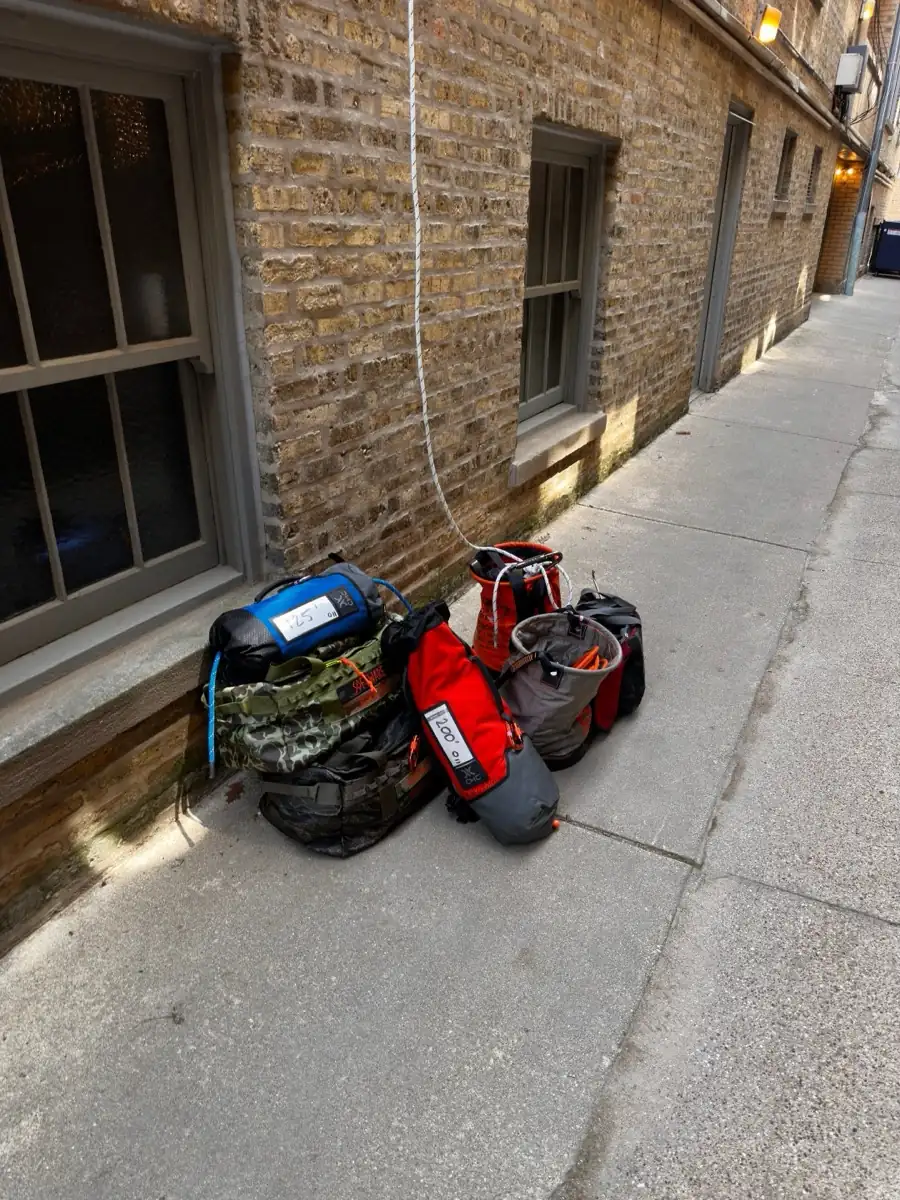
The first visit, on May 22, 2026, was an assessment, not a cleaning. Standing in the gangway looking up tells you most of what you need to know: the exact height and position of the vent relative to the parapet, whether the wall has anything that will foul a rope, whether the window below is a hazard, and where gear can be staged without blocking the walkway.
It also tells you what the roof needs to provide. A rope job is only as good as its anchors, and you do not want to discover on the day of the work that the parapet is soft or that there is nothing structural within reach of the vent line. Going up to look first is cheaper than improvising later.
Visit Two: Rigging the Roof
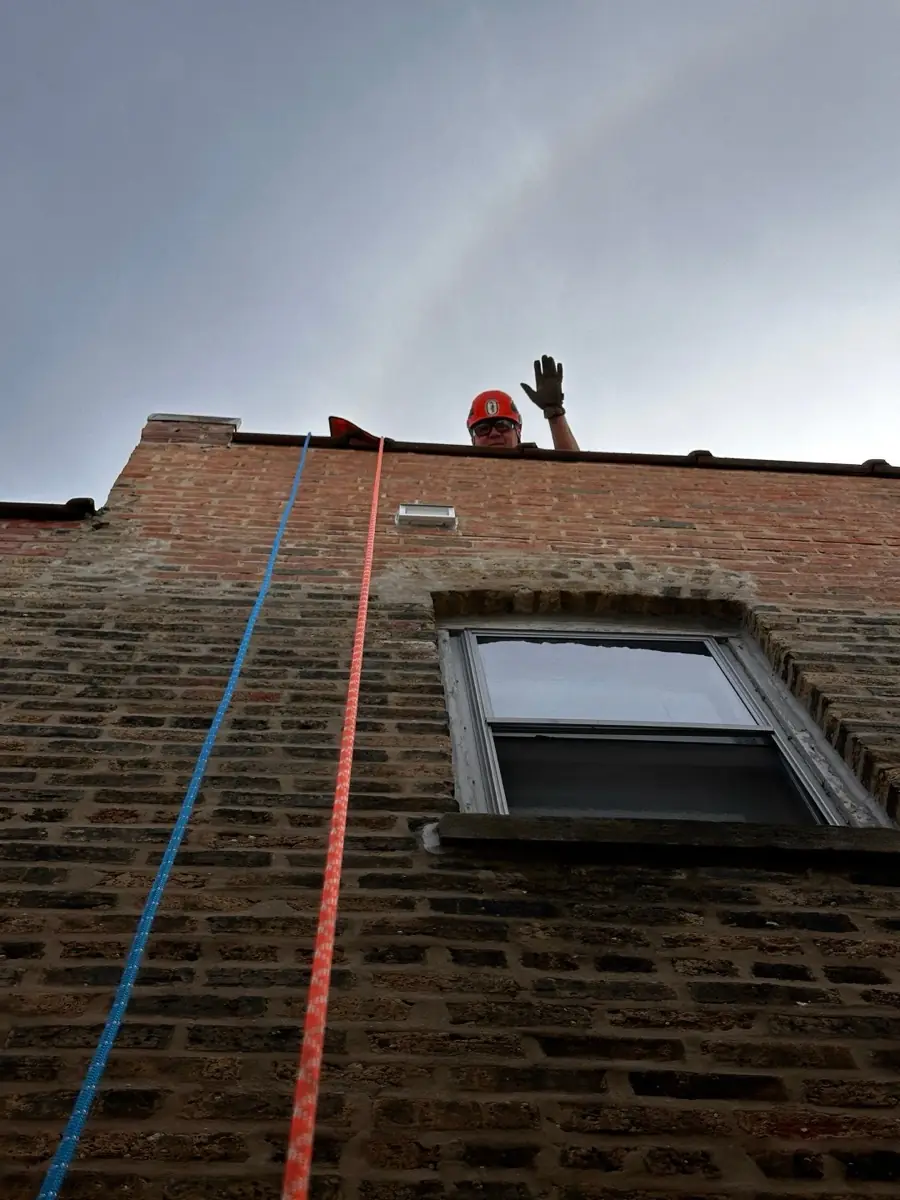
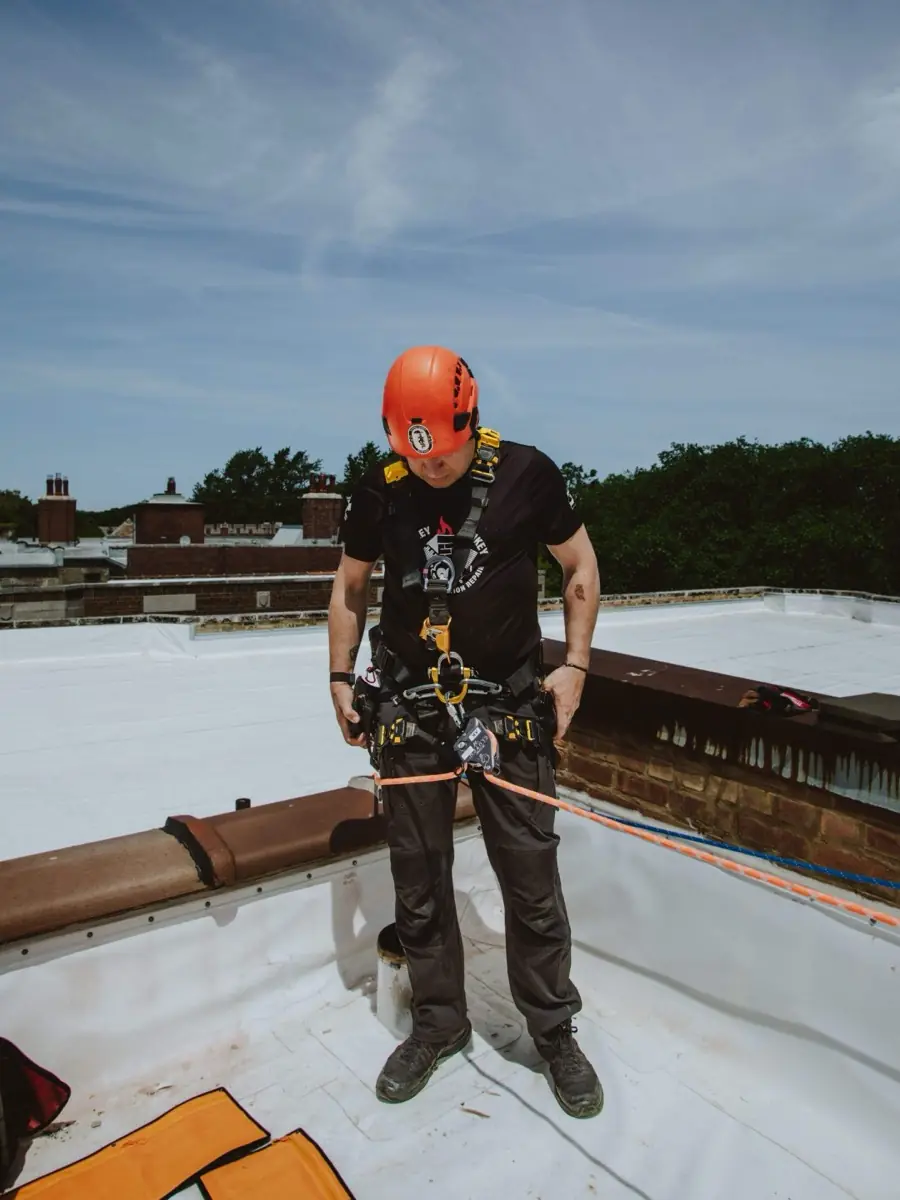
The work itself happened on May 27, 2026, in clear weather, with a two-technician team. Everything starts on the roof, well back from the edge. The building has a flat membrane roof behind a brick parapet, with masonry chimney stacks, which gives solid structure to build an anchor system on.
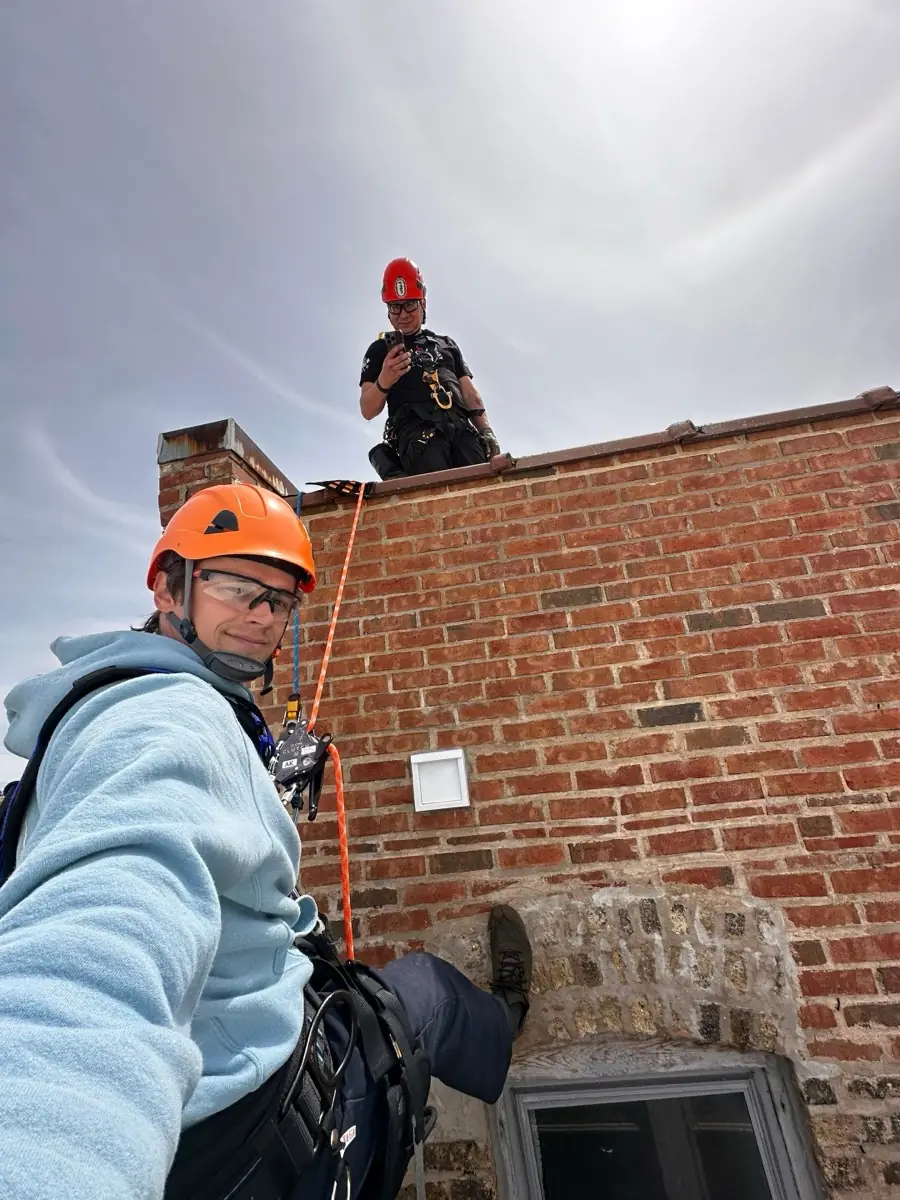
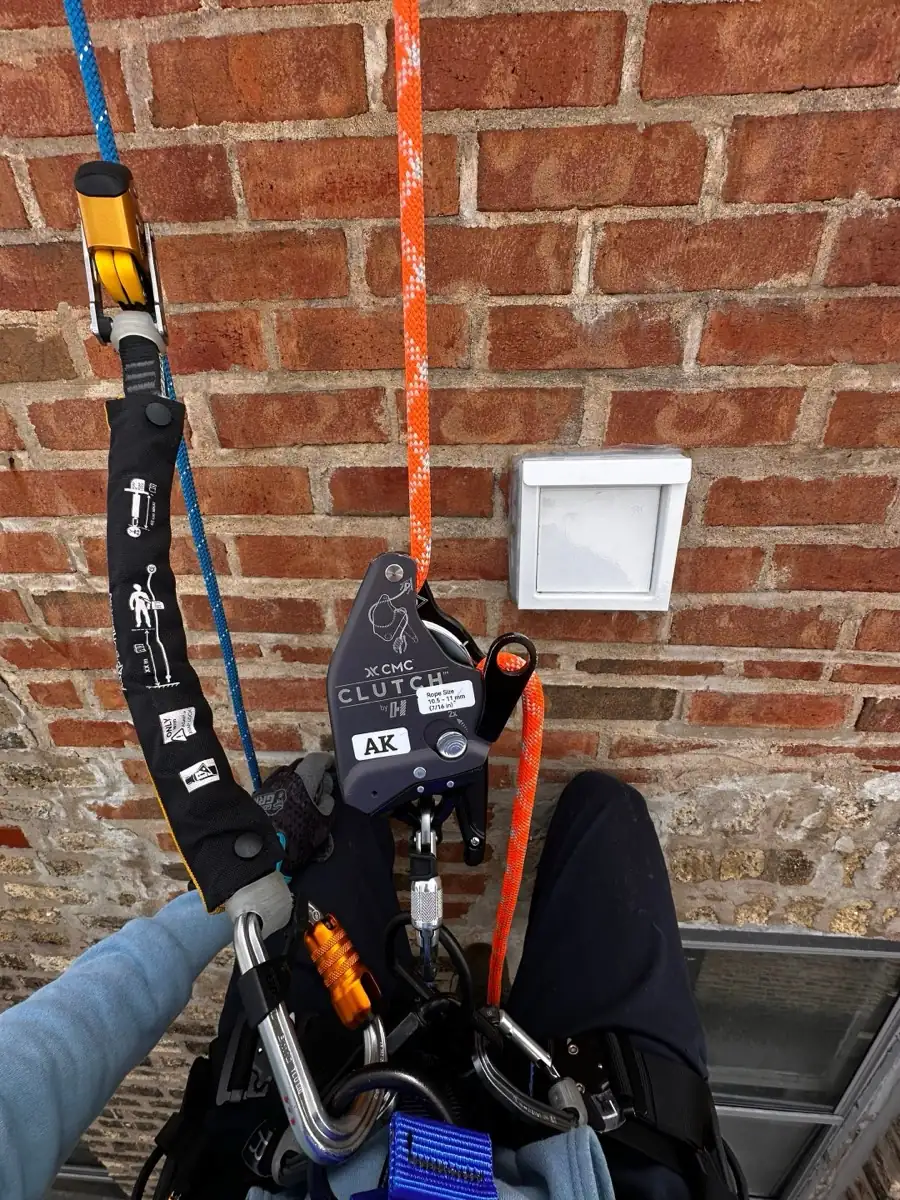
Two independent lines go over the edge: a working line that the technician descends on, and a separate backup line carrying a fall-arrest device. They are rigged to separate anchor points. That redundancy is the entire point of the method. If any single component of the working system fails, the backup line catches the technician without the load ever reaching the ground.
One technician goes over the edge. The second stays topside as the attendant, managing rope, watching the edge, and staying in contact with the person on the wall. Nobody works a rope job alone.
Working the Vent on Rope
The descent stops level with the vent, and the descender locks off. That is the difference that matters compared to a ladder: once the technician is parked at working height, both hands come free and stay free. The rope holds the body weight, so the work can be done properly rather than quickly.
From there it is the same job it would be at ground level. Pull the old cover, open up the duct, clear the packed lint and any nesting material out of the exterior run, brush and clear the duct back toward the interior until full four-inch airflow is restored, then check that the damper path is clear.
The Cover Is Not an Afterthought
A clean duct behind a broken cover is a temporary result. High wall vents take more wind than low ones, and the thin plastic louvers that ship on most vents go brittle and crack or snap off entirely. Once the opening is unguarded, a warm sheltered four-inch pipe is prime nesting real estate for starlings and sparrows, and you are back to a full blockage within a season.
So the last step on the rope was fitting a louvered metal cover with a gravity damper. It needs to do three things at once: exclude birds and rodents, let lint and hot air out without choking airflow, and survive Chicago freeze and thaw cycles without deforming. Getting that installed while already suspended at the vent costs very little extra. Coming back to do it later means paying to rig the whole building again.
Who Was on the Rope
High-access work in Chicago tends to be a small world, and we run this kind of job alongside Chimney Monkey, who work the same buildings from the same ropes on chimney and masonry side. When a team is already rigged on a roof, it is straightforward to look at the chimney crown, the caps, and the high gutters in the same visit, which is usually a better use of the setup than a single-item trip.
If your building needs flue or masonry attention as well as vent work, that is worth flagging up front so it can be planned into one rigging day. Our own chimney services page covers what we handle directly.
What a Job Like This Costs
Rope access is priced around the rigging, because that is where the time, the certification, and the equipment go. Our standard flat rates for high-access vent work are below. They replace the lift and scaffold rental costs that would otherwise land on a job like this, and in a gangway those options are not available at any price.
High-Access Vent Work:
Rope Access Setup and Service
- Anchor assessment and rigging
- Two-rope system with independent backup
- Two-technician team, one topside attendant
- Full duct clearing and lint removal
- Nest extraction and airflow check
- Louvered metal cover with gravity damper
- Bird and rodent exclusion
- Built for Chicago freeze and thaw
Why the Setup Drives the Price
- Rigging is the work: Anchor assessment, rope setup, and de-rigging take longer than the vent cleaning itself.
- The cleaning is cheap once you are there: Adding the duct work at $220 is minor next to the setup.
- The cover prevents a repeat: $200 fitted now avoids paying to rig the building again next spring.
- Bundle the rest of the roofline: High gutters, top-floor windows, and chimney checks all get cheaper on a setup that is already up.
Is Your Building the Same Story?
The pattern repeats across Chicago and the inner suburbs. If several of these are true, the vent is worth looking at:
- The laundry is on an upper floor and the vent exits onto a gangway, alley, or courtyard wall.
- Loads need two cycles, or the dryer shuts down partway through and needs to cool off.
- You cannot remember the vent ever being serviced, and neither can the previous owner.
- The flap on the outside wall does not move when the dryer is running, or there is no flap left at all.
- You have heard birds inside the laundry room wall in spring.
We cover this work across Chicago, Evanston, and the North Shore and Northwest suburbs. Our service areas page has the full list, and the dryer vent cleaning service page covers standard ground-level work.
Frequently Asked Questions
Got a Vent Nobody Will Touch?
Send us a photo from the ground and the approximate floor it sits on. We can usually tell from that whether it is a rope job, and what it will take to clear it.
Serving Chicago, Evanston, and the North Shore