
Why Roof Cleaning Is Important
The unique climate of the Chicagoland area creates significant challenges for maintaining exterior surfaces. High humidity combined with dense canopies of mature trees creates the perfect breeding ground for organic growth on roofing materials.
Homeowners frequently face common issues such as unsightly black streaks caused by Gloeocapsa Magma algae, invasive moss growth, and lichen formations. When left untreated, these organisms actively retain moisture against the roof surface, accelerate the deterioration of asphalt granules, and cause wood rot in cedar shakes.
Which slope is worst is rarely random. Algae takes the north and shaded faces first, so on most North Shore homes one side of the roof is visibly streaked while the other still looks new. That is the tell that it is organic growth rather than dirt, and it is why rain never shifts it.
Roof Washing Near You
Pane Pal is a roof washing company based in Palatine, Illinois. We clean roofs across the Northwest Suburbs and Chicago’s North Shore, and most jobs are inside a thirty minute drive of the shop. If you are looking for roof washing near you in Palatine, Arlington Heights, Barrington, Inverness, Schaumburg, Northbrook, Glenview, Winnetka, Wilmette, Highland Park or Lake Forest, we already work on your street.
Roof washing and roof soft washing are the same service. Soft washing is simply the method: low pressure and a cleaning solution that kills the algae, instead of the high pressure that blasts granules off shingles. If a roof washing company quotes you a pressure wash on asphalt shingle, that is the thing to ask about before you book.
Call or text 224-458-2496 for a free roof washing estimate. Every roof is quoted on its own, and the price is fixed before we start.
Serving Chicagoland Communities
We are a local exterior cleaning company working across the Northwest Suburbs and the North Shore. Each town below has its own page covering local roof types, access and scheduling.
What It Actually Looks Like
From a two-storey brick home in Inverness, Illinois. No staging, no stock photos.
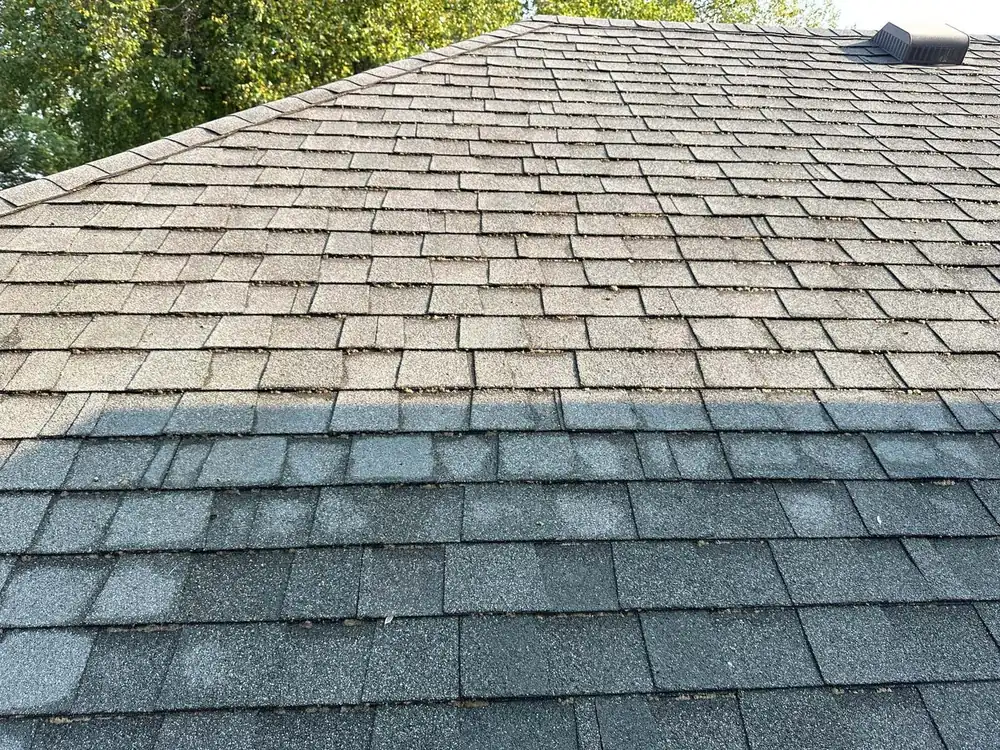
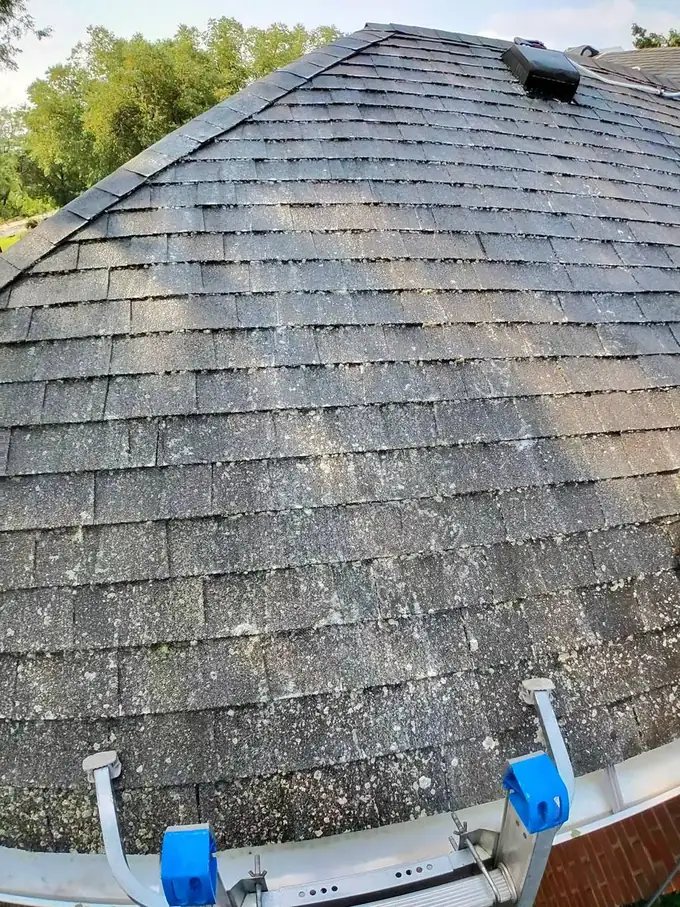
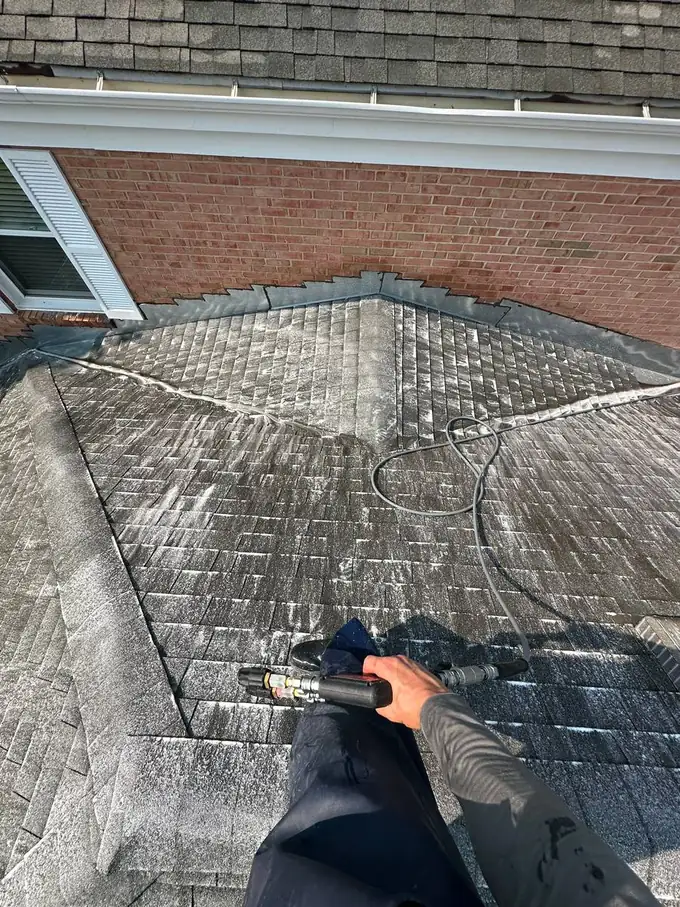
More on Roof Washing and Algae Removal
Roof Soft Washing FAQ
What causes the black streaks on my roof?
Gloeocapsa magma, a blue-green algae that feeds on the limestone filler in asphalt shingles. It takes hold on the north and shaded slopes first, which is why the streaking is usually worse on one side of the roof. It is not dirt, and it will not wash off in rain. Left alone it holds moisture against the shingle and shortens the roof's life.
Is roof washing the same as roof soft washing?
Same service, different words for it. Roof washing is what most people search for; soft washing describes the method, low pressure plus a cleaning solution rather than mechanical force. The distinction that actually matters is soft wash versus pressure wash. Pressure washing an asphalt shingle roof strips the granules that protect it and takes years off its life, which is why we never do it.
Will roof cleaning damage my shingles?
Pressure washing will. It strips the coloured granules that protect the asphalt underneath, and once those are in the gutter they do not go back. Soft washing uses no pressure at all: a cleaning solution does the work, dwells, and then gets rinsed off. The Asphalt Roofing Manufacturers Association calls for exactly this, a low-pressure approach with a thorough rinse, rather than mechanical force.
Is soft washing safe for cedar shake?
Yes, and cedar is where the difference matters most. Pressure on cedar raises the grain, splinters the shakes and takes years off the roof. We use a low-pressure application and a solution chosen to kill moss and lichen without bleaching the wood or drying out the fibres.
Do you rinse the roof afterwards, or leave the solution on it?
We rinse, fully. Some cleaners spray and drive away, letting rain deal with it. That leaves solution sitting on the shingles and running onto whatever is below in an uncontrolled way. We rinse the roof down completely and then flush the landscaping, driveway and foundation plantings the runoff touched. On our last Inverness job the rinse and neutralise stage took longer than the application did.
What happens to my plants and landscaping?
They get pre-wetted before anything is applied, which stops the solution soaking in, and flushed again afterwards. We look at what is actually growing under the drip line first. On one job the beds ran straight along the brick foundation with staked tomatoes in them, so those got covered as well as wetted.
How often should a roof be cleaned in the North Shore?
Every three to five years for most homes here. Shaded north slopes and roofs under mature oaks or maples come back faster, sometimes closer to every two or three years. If you can see distinct dark streaks from the street, it is already well established.
How much does roof soft washing cost?
It is quoted per roof rather than off a price list, because pitch, storeys, roof material, access and how far the growth has gone all change the job substantially. Metal roofs are priced by area at $0.35 per square foot, and a detached garage on its own is $125 for a single and $150 for a double. Estimates are free, and the quote is fixed before we start.