
When Is It Too Cold for Roof Washing in Chicago?
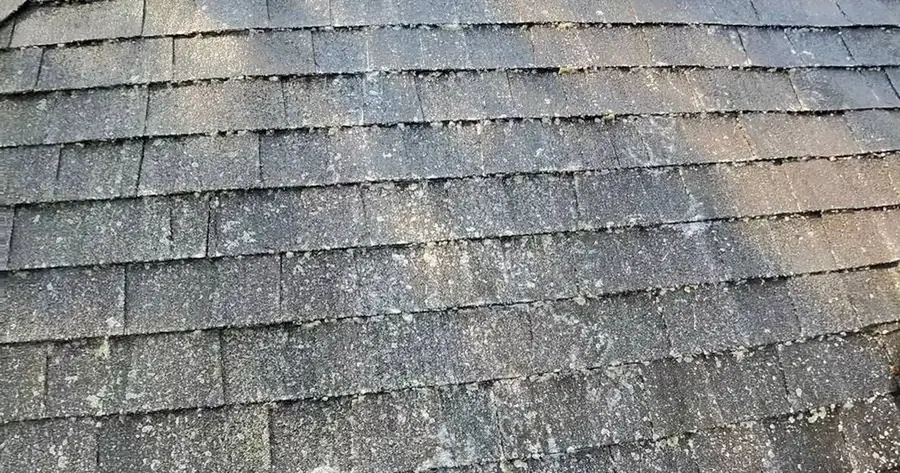
Short answer: we stop booking roof soft washes when the day of the job will not reach about 50°F, or when the night before or after it is forecast to freeze. In a normal Chicago year that happens somewhere between late October and the first week of November, and we start again once the last spring freeze is behind us, usually late April. The cleaning solution itself is not the problem at those temperatures. Everything around it is: the rinse water, the gutters, the shingles, and the driveway the runoff lands on.
This post is for homeowners trying to decide whether to book now or wait, and for other exterior cleaning companies working out where to draw their own line. It also walks through our full process, including how we use NeutraPods to neutralize the runoff before it reaches your beds and lawn.
Key takeaways
- Our cutoff: a forecast high of at least 50°F on the job day, no freeze the night before or after, and a roof that is dry of frost by mid-morning.
- O’Hare averages a 62.7°F high and 45.4°F low in October, and 48.4°F and 34.1°F in November. Its normal first freeze is October 19.
- Roof wash solution does not freeze at those temperatures. Rinse water, iced gutters and brittle shingles are what end the season.
- NeutraPods in the downspouts neutralize the runoff before it reaches the soil, but only if the gutters and downspouts are actually flowing.
- Missed the window? Wait for spring. The growth will still come off in April. A shingle cracked on a frozen morning will not fix itself.
Our cutoff, in three conditions
We book a roof soft wash only when all three of these are true for the day of the job:
- The forecast high is 50°F or warmer. Below that the solution works slowly, the dwell stretches, and the job starts running into the short afternoon light.
- No freeze the night before, and none the night after. The night before decides whether there is frost on the shingles and ice in the gutters when we arrive. The night after decides whether the rinse water left on your driveway and walks turns into a sheet of ice by the time you take the trash out.
- The roof is dry of frost and dew by mid-morning. North-facing slopes and slopes under big oaks and maples can stay wet until noon in late October, even on a day that reaches the 50s.
If any one of them fails, we move the job. That means our last roof of the year is set by the forecast, not by a date on the calendar. Some years it is the third week of October, some years the first week of November.
What a Chicago fall looks like on paper
The National Weather Service publishes 30-year temperature normals for O’Hare. October averages a 62.7°F high and a 45.4°F low. November drops to 48.4°F and 34.1°F, which fails both of our first two conditions on an average day (National Weather Service Chicago, 1991 to 2020 normals, retrieved September 2026).
On average, April through October clear both lines and March and November do not. Averages hide the swings, though. October regularly hands out a week in the 70s followed by a frost the next Tuesday, which is exactly why we decide job by job from the forecast.
The freeze dates tell the same story. O’Hare’s normal first fall freeze is October 19 (NWS Chicago first freeze data) and its normal last spring freeze is April 21 (NWS Chicago last freeze data). Rockford, farther northwest, averages its first freeze on October 13. Homes away from the lake and the city, which describes most of the Northwest Suburbs, tend to frost earlier than the airport thermometer suggests. A Palatine or Barrington roof can be white at 7am on a morning the O’Hare forecast called mild.
| Month | Avg high | Avg low | Our call |
|---|---|---|---|
| March | 47.0°F | 31.0°F | Closed |
| April | 59.0°F | 40.3°F | Opens after the last freeze |
| May to August | 70.5 to 84.5°F | 50.6 to 66.4°F | Open (watch hot afternoons) |
| September | 75.5°F | 57.1°F | Open |
| October | 62.7°F | 45.4°F | Open, day by day after the first frost |
| November | 48.4°F | 34.1°F | Usually closed |
| December to February | 31.6 to 36.6°F | 18.8 to 24.4°F | Closed |
Why cold weather ends the season (it is not the bleach)
You will see it said online that roof wash solution freezes in the low 40s. It does not. The safety data sheet for HASA’s 12.5% sodium hypochlorite, the concentrate soft wash companies mix from, lists a freezing point of -10°F (HASA safety data sheet, revision January 2020). The concentrate in the tank is fine on a cold morning. Four other things are not.
1. The solution slows down
Sodium hypochlorite kills algae, moss and lichen by oxidizing them, and like most chemical reactions it runs slower in the cold. On a cool day the dwell stretches and the result comes out patchy. The tempting fix is a stronger mix, which puts more chlorine into the runoff and onto the landscaping. We would rather wait for a warmer day than turn the strength up.
2. The water freezes where you cannot see it
The mix on the roof is mostly water, and the rinse is all water. That water ends up in the gutters, the downspouts, the underground drain lines, and across the driveway and walks. A frozen downspout backs runoff up into the gutter. A rinsed driveway that freezes overnight is a slip hazard on your property the next morning. Neither shows up until after we have left.
3. Cold shingles crack underfoot
Asphalt shingles stiffen as they get cold. The Asphalt Roofing Manufacturers Association tells anyone doing roof maintenance in cold weather to take special care walking on shingles, and warns that curved or buckled shingles are “very susceptible to breakage underfoot in frigid weather” (ARMA cold weather recommendations, retrieved September 2026). The roofs that need washing are the ones most likely to have lifted, curling tabs, because moss growing between the shingles pushes the edges up. That is the worst roof to walk on at 38°F.
4. Short days, slow drying, frosty slopes
Daylight saving time ends on November 1 this year, and after that the sun is down around 4:30 in the afternoon. A roof wash needs time for setup, application, dwell, a full rinse and a full flush of the ground, all in daylight on a dry roof. Late in the season, shaded slopes may not lose their frost until late morning, and a rinsed roof dries slowly. The working day shrinks from both ends.
How we wash a roof, start to finish
The cold-weather rules make more sense once you see what a roof wash actually involves. Here is our process in order. The long version, with photos from a full job in Inverness, is in our roof soft washing process post.
- Walk the property. Before anything gets wet we note every bed, vegetable garden, pond and shrub under the drip line, and where each downspout discharges.
- Make sure the water has somewhere to go. Gutters and downspouts have to flow, because they carry the runoff. In the fall that often means clearing leaves first.
- Place NeutraPods in the downspouts. More on these below.
- Pre-wet everything the runoff will touch. Beds, lawn edges, the driveway and walks get soaked with plain water so anything that lands on them is diluted on contact.
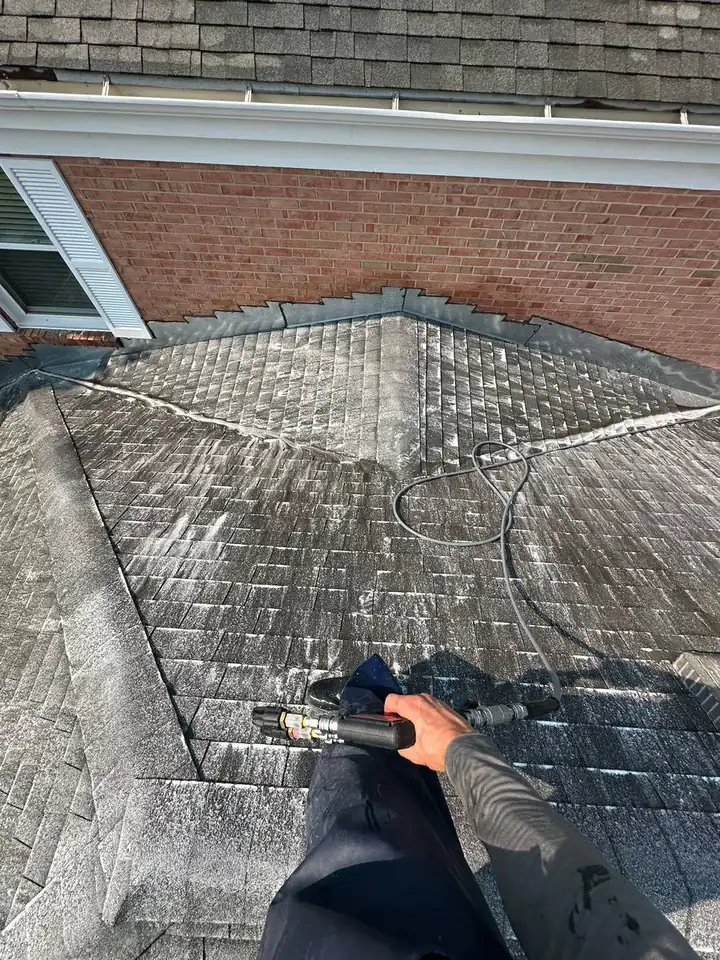
- Apply the solution at low pressure. Soft washing uses a cleaning solution and gentle pressure, not force. Pressure washing strips the granules that protect asphalt shingles, which is why we never do it. See soft washing vs pressure washing a roof.
- Dwell, and watch the clock. ARMA’s own cleaning guidance calls for 15 to 20 minutes of dwell, and the solution must not dry on the shingles.
- Rinse the whole roof. Low-pressure water, every slope, until the runoff runs clean. This is the step that sends the runoff through the gutters and the NeutraPods.
- Flush the ground again. Every bed, lawn edge and hard surface that took runoff gets another round of clean water before we pack up, including brick and stone below the roofline.
What NeutraPods do, and where we put them
NeutraPods are a sodium hypochlorite neutralizer sealed inside a water soluble pouch, made for soft wash crews (product listing). The pouch dissolves completely in water, so there is nothing to fish out of your downspout afterwards.
Here is how we use them on a roof wash:
- Before any solution goes on the roof, we drop a NeutraPod into each downspout that drains toward planting beds, lawn or a garden.
- During the rinse, roof runoff collects in the gutter, runs down the downspout and dissolves the pouch on the way. The neutralizer travels with the water, so the bleach in the runoff is neutralized inside the pipe, before it reaches the soil.
- After the rinse, the pre-wet and the final flush handle what never went through a downspout, such as drift and drip along the eaves.
NeutraPods do not replace rinsing. They are one layer of three: soak before, neutralize in the downspout, flush after. Each one covers a different path the runoff can take.
There is a cold-weather catch, and it is the part most people miss. A pod only works if the water goes through it. In late fall the gutters are packed with leaves and the downspouts may be partly iced. Runoff then spills over the gutter lip and lands straight in the beds, right past the pod. That is another reason we check that the gutters flow before a fall roof wash, and another reason we stop once they start freezing. If yours are full, gutter cleaning comes first.
For exterior cleaning companies: our cold-weather go or no-go check
If you run a soft wash crew in Chicagoland, here is the check we run before every roof from October on. Draw your own line, but draw it before the customer asks.
- Forecast high of 50°F or more on the job day, checked the evening before and again that morning.
- Overnight low above freezing the night before and the night after. A clear, calm night can frost a roof even when the forecast low is in the mid 30s.
- Shaded and north slopes checked for frost before anyone steps off the ladder.
- Gutters and downspouts flowing, with neutralizer in place before the first spray.
- Enough daylight for application, dwell, a full rinse and a full ground flush, with time left to drain hoses and lines.
- Equipment drained at the end of the day. A pump or hose reel that freezes overnight costs more than the job paid.
- Customers told early. Say in September that the window closes in October. The late-October rush books itself sooner, and nobody is surprised by a spring date.
Missed the window? What homeowners should do
If it is still early October and the forecast cooperates, there is time. Once November arrives, our advice is simple: wait for spring. The algae, moss and lichen will still be there in April and will come off the same way. A cracked shingle from a frozen morning will not repair itself, and a roof wash rushed into the cold tends to be weaker, with more runoff risk to your landscaping.
Meanwhile:
- Get the gutters cleaned after the leaves drop. Late fall gutter cleaning is still fine in the cold, and it protects against ice dams. See our gutter cleaning service.
- Get the estimate now, book the wash for spring. Our roof soft washing service page covers what is included and how it is priced.
- Know what you are looking at. Black streaks are algae, green fuzz is moss, and gray green crusty patches are lichen. Why roofs develop black streaks explains the algae, and cedar roofs have their own rules in our cedar shake maintenance guide.
Book before the window closes
We soft wash roofs from Palatine across the Northwest Suburbs and the North Shore, including Palatine, Arlington Heights, Barrington, Northbrook and Winnetka. If you want your roof done this year, request a free estimate or call and text 224-458-2496 while the forecast still has 50s in it. If the season has already closed, you can still get the estimate now and book the wash for spring.
Common questions
Can you soft wash a roof in winter in Chicago?
We do not. Between roughly November and mid April the days rarely reach 50°F and most nights freeze, so the rinse water ices up in the gutters, downspouts and on the driveway, and cold shingles crack more easily underfoot. You can still get the estimate in winter, and the wash goes on the schedule for the first mild stretch after the last spring freeze, which at O'Hare is normally April 21.
Is 40°F too cold to wash a roof?
For us, yes. Our floor is a forecast high of 50°F on the day of the job, with no freeze the night before or after. Some contractors work in the 40s, but the solution works more slowly, the rinse dries slowly, and a clear night afterwards can glaze the driveway and walks with ice.
Does roof cleaning solution freeze in cold weather?
The concentrate does not. The safety data sheet for HASA 12.5% sodium hypochlorite lists a freezing point of -10°F. What freezes is the water: the mix on the roof is mostly water, the rinse is all water, and that water ends up in gutters, downspouts and on hard surfaces.
What are NeutraPods?
NeutraPods are a sodium hypochlorite neutralizer sealed in a water soluble pouch. We drop them into the downspouts that drain toward beds, lawn or gardens before we start. When the roof is rinsed, the runoff dissolves the pouch on its way down and carries the neutralizer with it, so the bleach is neutralized before it reaches the soil. The pouch dissolves completely, so nothing is left in the downspout.
Will roof washing in the fall kill my plants?
It can if nothing is done about the runoff. We soak beds and lawn edges with plain water before any solution goes on, place NeutraPods in the downspouts, and flush everything that took runoff again before we leave. In late fall the extra risk is gutters packed with leaves, because runoff then spills over the gutter edge straight into the beds instead of passing through the downspout, so we check that the gutters flow first.
When is the best time of year to wash a roof in Chicago?
Any dry stretch from late April through mid October, once nights stay above freezing and days reach the 50s or warmer. Late spring and early fall are the easiest: warm enough for the solution to work, cool enough that it does not dry on the shingles before the rinse.
Author: Pane Pal Exterior Cleaning Team
Based in Palatine, IL, the Pane Pal team specializes in expert exterior cleaning across the Chicago North Shore. From delicate cedar shake roofs in Winnetka to solar panels in Highland Park, we bring years of specialized knowledge to protect and beautify your home.
Protect Your Home with Professional Exterior Cleaning
Ready to restore your home's curb appeal safely and effectively? Contact our expert team today for a comprehensive evaluation.